


Leather Test

So we decided to actually test it. Nothing simpler than sending everything off for testing at the German certification body TÜVRheinland® and waiting for the result. In practice it wasn't quite that simple, but that's a story for another time.
The result?
The soft, waxed leather we use for jackets, for example, held up for 8.82s in testing to EN 13595-2:2002.
The leather we use for suits and trousers went even further — it held up for 11.2s!
What does that mean in practice?
For a garment's material to earn a "LEVEL" 1 or 2 rating, it has to meet the requirements of the relevant standard. Note: this is about the outer material itself, not the protectors fitted inside the garment. The test simulates a speed of 8 m/s (28.8 km/h).
For a Level 1 rating, the material has to resist abrasion under impact for 4 seconds — roughly speaking, that's 32 metres of sliding on your backside.
For a Level 2 rating, the material has to resist abrasion under impact for 7 seconds — roughly 56 metres of sliding.
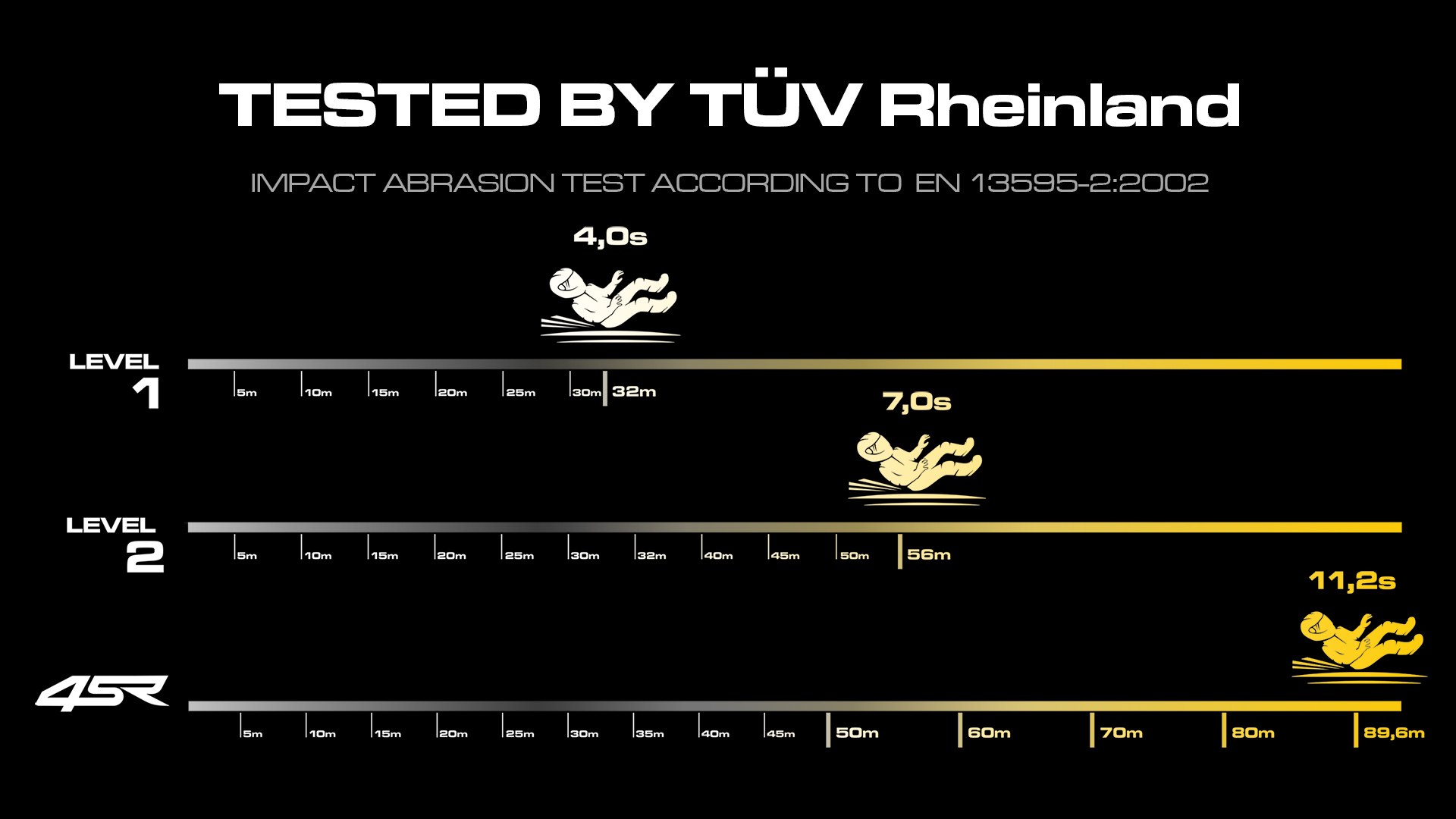
How did we do? In a 4SR suit, you could slide a full 89.6m without a problem! On the most stressed areas — shoulders, elbows, and backside — we use a double layer of leather. So you could effectively double that result again.
What this also means is that leather is, and will remain, the safest material available for building motorcycle gear — not even fibres stronger than steel can match it.
Though we should add: we're talking specifically about the leather we use to build 4SR gear. As it turns out, not all leather is created equal.